

China needs to strategically revalue the renminbi to achieve global tech and monetary dominance: Lian Ping
Appreciation of the Chinese currency viewed as economically inevitable.

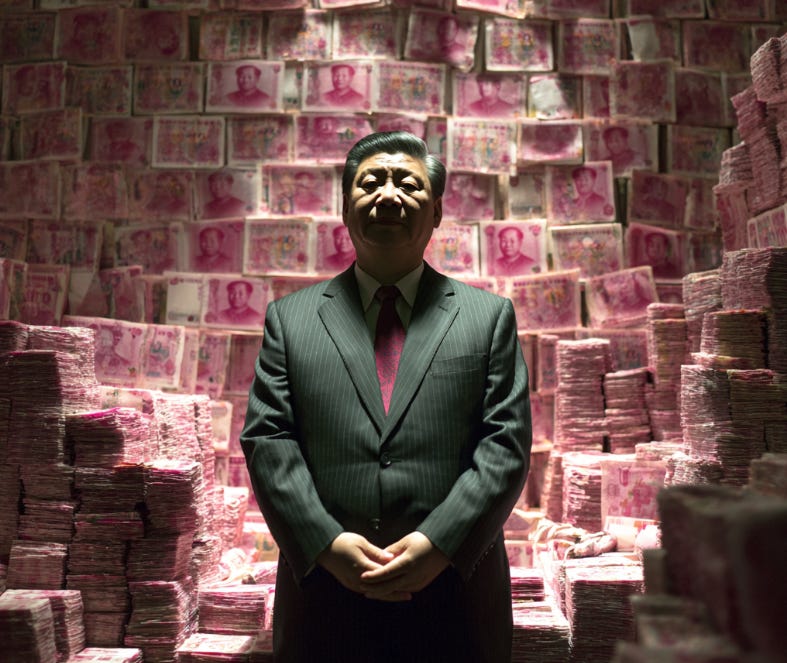
As Trump’s tariff war fails to make a significant dent in the export powerhouse of the Chinese industrial machine, Western economists have stepped up their calls for Beijing to revalue the renminbi.
Economists such as Brad Setser have long asserted that the renminbi is massively undervalued, leading to huge trade imbalances and China’s accumulation of a massive current account surplus.
Leading economists within China have also joined the chorus of calls from abroad advocating for appreciation of the nation’s official currency.
Lian Ping (连平) - director of the China Chief Economists Forum, wants the Chinese central bank to implement a strategic appreciation of the renminbi appreciation during the course of the 15th Five Year Plan, set to run from 2026 to 2030.
“During the 15th Five Year Plan, we should allow the renminbi to appreciate against the US dollar in a moderate and orderly manner, driven by supply and demand on the market,” Lian writes in a recent opinion piece, “A Strategy of Renminbi Appreciation Should Be Implemented During the 15th Five Year Plan” (“连平:“十五五”时期应实施人民币升值战略”).
“This will be of the utmost importance for medium and long-term strategies including the expansion of wealth, invigorating consumption, scientific and technological innovation and the internationalisation of the renminbi.”
Is the renminbi undervalued?
In 2005, China made the momentous decision to remove the renminbi’s peg to the US dollar, permitting its value to fluctuate within a narrow band as part of a longer-term transition towards full free market floating.
Ten years later, however, the Chinese central bank shocked international markets by announcing a succession of three devaluations starting on 11 August 2015 that would eventually shave the renminbi’s value by 3%.
Lian says the move marked the start of a decade of steady depreciation that would cumulatively reach 15% by the start of the first half of 2025.
He argues that this depreciation trend runs contrary to the rapid shift in the economic fundamentals of both China and the US over the past ten years - particularly given the concurrent increase in the scale of China’s economy and the quality and scope of its output of goods and services.
“During this period, China’s economic growth was markedly higher than that of the US, and the current account ran up multiple consecutive years of very high surpluses,” he writes.
“Balance of payments fundamentals were stable, and foreign reserves were ample.
“In comparison, the US current accounts deficit further expanded, its fiscal deficit has continually expanded, and government debt has repeatedly tapped new highs.
“We can see that during this time, the depreciation trend of the renminbi has not at all been a reflection of economic fundamentals, but instead an excessive reaction to short-term market sentiment and one-sided expectations compounded by external shocks.”
Lian further points to the stark divergence in inflationary trends between China and the US since Covid as evidence that the renminbi is at present undervalued.
The US - like many other OECD nations - needed to hike interest rates shortly following the onset of the Covid to deal with a painful spike in inflation, which pundits blamed on either supply chain shocks or copious fiscal spending designed to keep the economy afloat through the worst of the pandemic.
China - by sharp contrast - faced no such inflationary dilemma. It instead now finds itself grappling with deflationary pressure, which many impute to the shortfall in domestic demand created by its property slump.
This diverging inflationary trend has led to an increasing shift in the purchasing power of the two nations’ currencies.
“From the perspective of purchasing power, the exchange rate fluctuations between the currencies of two different nations should largely offset the differences in their inflation rates,” Lian writes.
“Following the pandemic, the price of US goods has risen considerably, while prices for goods in China have been relatively stable.
“This, in turn, proves that the renminbi is undervalued, and thus possesses intrinsic appreciation pressure relative to the US dollar.”
Lian cites research indicating that the renminbi was likely undervalued relative to the US dollar by anywhere from 6 - 15% during the period from 2022 - 2024.
Renminbi appreciation pressure set to further accrue
Lian sees pressure for the renminbi to appreciate against the US dollar continuing to rise in future, as China’s economic growth outpaces the US, Chinese household wealth further expands and rates of inflation further diverge.
He expects China’s pursuit of tech-driven industrial dominance as the key support for appreciation of the renminbi, by increasing demand for the Chinese currency abroad and piling the nation’s current account surplus even higher.
“The ongoing current account surplus will form a support for appreciation of the renminbi via supply and demand on forex markets,” Lian writes.
“China possesses the most complete industrial system in the world, the quality of its labour force continues to improve, while industrial robots and other forms of smart automation are spreading with increased speed.
“Over the next five years, the development of new quality forces of production will drive growth in the export of high-end manufactures, thus further supporting renminbi appreciation via market supply and demand relations.”
Lian also expects the problems of the US economy as supporting the appreciation of the renminbi, by putting downwards pressure on the dollar and undermining its incumbent hegemonic position
He points firstly to the adverse impact of the Trump administration on the credibility of the US as a responsible economic power - highlighting the president’s efforts to pressure the US Federal Reserve to reduce interest rates, thus compromising its integrity as an independent central bank.
The Liberation Day tariffs have also weakened the US dollar’s status as a dependable medium of settlement and exchange for the international community. This has exacerbated concerns created by Washington’s prior use of financial sanctions against geopolitical adversaries - an expedient that Chinese pundits are wont to refer to as “weaponisation of the dollar.”
Lian further points to the ongoing expansion of US federal government debt - which breached a historic high of US$38 trillion in October of this year, as “markedly weakening US dollar forecasts.”
The upshot of all these challenges could be “global de-dollarisation” and the emergence of a multi-polar international monetary system, giving greater play and support to peer currencies such as the renminbi.
“De-dollarisation has evolved into a trend of coordination across multiple sectors, currencies and systems, which will further weaken US dollar hegemony and strengthen pressure on the US dollar to depreciate,” Lian writes.
The benefits for China of a rising renminbi
Lian sees the appreciation of the renminbi as having benefits for the Chinese economy across four key areas:
Achieving China’s goal of becoming a developed economy by 2035
Transforming China into the world’s leading market for consumption and imports.
Accelerating China’s scientific and technological innovation.
Driving the internationalisation of the renminbi.
China intent on developed economy status by 2025
Beijing has set the goal of China becoming a “mid-tier developed nation” in terms of per-capita GDP by 2035.
This requires per capita GDP to reach at least US$20,000, which in turn entails achieving average per annum growth of between 4 - 5% for the next decade, given China’s per capita GDP stood at US$13,445 in 2024.
The Chinese central government has recently stressed the role of rising asset prices in raising average levels of affluence in China, as part of efforts to step up domestic consumption via “wealth effects.”
Lian argues that appreciation of the renminbi will also enable China to leverage such wealth effects to achieve its 2035 goal of achieving developed nation status, by enhancing the ability of everyday Chinese to invest in global markets.
“If the renminbi moderately appreciates, then the overseas investments and global asset allocation ability [of Chinese households] will markedly increase,” he writes.
“Improvements to asset-based income will drive improvements to living standards, as well as further optimisation of the scale and structure of their wealth.”
China as world’s largest consumer market
Lian says there is still a 10 - 30 percentage point gap between Chinese household consumption as a share of GDP compared to developed economies, with services consumption at especially low levels.
Since the Covid pandemic, China’s domestic consumption growth has further weakened, with many imputing the issue to balance sheet damage caused by the housing slump.
In 2021, China had become the world’s second largest consumer market, with domestic consumption of US$6.83 trillion - equal to 92.12% of US consumption, which stood at US$7.41 trillion that year.
By 2024, however, China’s consumption had only lifted to US$6.85 trillion - by that 80.18% of US consumption at US$8.54 trillion for the same year.
Lian sees appreciation of the renminbi as one of the solutions to boosting consumption and thus expanding China’s weak domestic demand - considered by policymakers to be one of the biggest challenges currency facing the economy,
“A moderate appreciation of the renminbi can be a key lever for unleashing the enormous consumption potential of China’s massive population of 1.4 billion,” he writes.
“[It] will lead to increased purchasing power and optimized consumption patterns, propelling China’s consumer market to continuously approach and ultimately surpass that of the US.”
This will also burnish China’s lustre as an market for imports, helping to reduce the mounting trade imbalances that are one of the most celebrated causes of complaint for overseas critics of Beijing’s economic policies.
“Allowing the renminbi to moderately appreciate will enable China to more rapidly rise to become the world’s largest import market, helping to deal with the problem of excessively large trade surpluses, and easing up international economic relations,” Lian writes.
Accelerating China’s tech ascendance
Lian argues that appreciation of the renminbi can serve as a “strategic lever” for driving China’s scientific and technological innovation.
It will firstly reduce the cost of hi-tech imports in areas where China is still highly dependent on foreign products - including semi-conductors, jet engines and high-end research reagents.
These costs remain considerable, given that in 2024 China’s imports of hi-tech products accounted for around 30% of its total imports.
“A moderate appreciation of the renminbi will considerably reduce the prices of imported technology and equipment,” Lian writes.
Lian further points out that the appreciation of the renminbi will raise the relative value of domestic financial assets, making foreign capital more inclined to flow into the Chinese market to help drive the growth of domestic tech enterprises.
Internationalisation of the renminbi
A final strategic goal for Beijing that renminbi appreciation can advance is the internationalisation of the renminbi.
The 15th Five Year Plan is set to see China “drive renminbi internationalisation, raise the openness of the capital account, and establish a sovereign and controllable renminbi cross-border payments and settlement system.”
Lian contends that in order for the renminbi to become a credible competitor to the US dollar and the euro, it’s critical for it to undergo appreciation in order shore up its status as a store of value - one of the three key functions of any monetary medium, alongside serving as a medium of exchange and a unit of account.
“Any money which suffers from long-term weakness cannot possibly become an international currency that is widely accepted by the global community,” he writes.
“In the near-future, moderate appreciation of the renminbi will continue to drive its internationalisation.”
This debate is too simplistic. Embedded complex global value chains mean that the impacts of exchange rates are simply not as straightforward as mainstream arguments would lead people to believe. Those who argue for RMB appreciation in the name of reducing China’s trade surplus could well be disappointed as the appreciation paradox kicks in. That’s not a reason for China to not contemplate a progressive staged appreciation but western analysts need to be careful, very careful, what they wish for. See my recent essay: https://open.substack.com/pub/warwickpowell/p/hold-your-horses?r=1p62fw&utm_medium=ios&shareImageVariant=overlay
Dr. Lian’s proposal reads like a classic 'Trial Balloon'—testing the waters, not charting the course.
From a ChinArb perspective, the 'RMB Appreciation' narrative is a dangerous distraction.
Let’s look at the physics: China’s manufacturing base is facing the stiffest tariff headwinds in history. Appreciating the currency now would be industrial suicide. The priority is Survival, not 'Developed Nation' vanity metrics.
Don't believe the hype of a massive rally. The real arbitrage here isn't Long RMB; it's Short Volatility. We bet on Stability—a managed, narrow fluctuation band that protects exporters while preventing panic. In a chaotic world, the 'Boring' trade is the winning trade. 【https://chinarbitrageur.substack.com/p/the-industrial-standard-why-the-rmb】