

Top Chinese deficit hawk sounds alarm over debt crisis
Beijing's quest for developed economy status set to drive fiscal expansion for a decade.

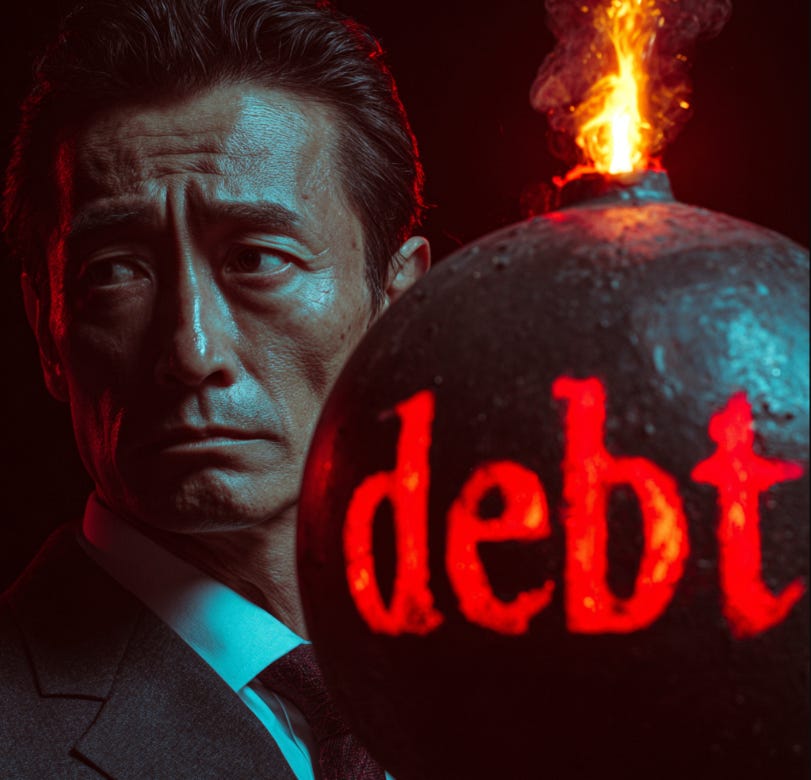
A leading Chinese economist argues that China will eventually succumb to a calamitous debt crisis, if Beijing continues to resort to short-term stimulus measures to satisfy long-term growth imperatives.
Liu Xiaoshu (刘晓曙), director of the China Chief Economist Forum and chief economist at Bank of Qingdao, has taken aim at deficit doves in a recent opinion piece, arguing that the incessant use of fiscal stimulus will create far more perils than benefits over the long-haul.
He instead advocates for long-term structural adjustments to the Chinese economy via more restrained macroeconomic measures, as the most effective solution for achieving sustainable growth.
Deficit hawks and doves battle over fiscal stimulus
China’s policy circles are host to a plethora of deficit doves, clamouring for Beijing to take on more debt to fuel the fiscal spending they believe is needed to keep the economy on track.
They’ve helped to drive China’s official deficit ratio for 2025 to 4% - the highest level on record, as well as a full percentage point above the threshold set in 2024.
Lian Ping (连平), an academic at East China Normal University, expects Beijing to keep both fiscal and monetary policy loose for the next decade, in order to satisfy the core development goal of China achieving “middle-developed nation” levels of per capita income by 2035.
Strident deficit hawks are out in force as well, however, with Liu Xiaoshu ranking prominently amongst them.
He’s launched a broadside against long-term fiscal stimulus in a recent opinion piece entitled: “The short–term sum is not equal to long-term gains - a sober reflection on economic stimulus” (“短期的加总不等于长期,对经济刺激的冷思考”).
“There’s a widespread misconception that continuously boosting the economy through short-term stimulus measures will achieve long-term prosperity,” he writes.
“If you’re skeptical about this, just look at today’s academics and industry professionals.
“When the economy dips, they immediately call for government stimulus policies, offering their advice and pontificating.
“When the economy improves, they attribute it to their own efforts, believing that stimulus is indeed necessary. Once the stimulus wears off and the economy declines again, new calls for stimulus begin.”
Liu argues that their views are misguided, on the grounds that the relationship between short and long-term policy impacts are highly complex, and cannot be reduced to just a simple process of linear addition.
“In the eyes [of deficit doves], since stimulus is effective in the short-term, why shouldn’t we keep stimulating. Shouldn’t this be capable of long-term effectiveness?
“Short-term gains do not equate to long-term gains, and continuously relying on short-term stimulus to drive economic growth cannot achieve true long-term prosperity.
“Only by abandoning excessive dependence on short-term stimulus and focusing on long-term structural reforms and development can a solid foundation be laid for sustainable economic growth.”
The perils of fiscal stimulus
Liu points to two dangers in particular when it comes to using short-term stimulus measures to continually prime the Chinese economy over lengthy time frames: market distortion and an eventual debt crisis.
Market distortions - zombie companies and household consumption
A key concern for Liu is that short-term stimulus measures will disrupt the price signalling function of the market, as well as its ability to effectively perform resource allocation.
Businesses and consumers could become excessively dependent upon large-scale fiscal spending and loose monetary policy, which will warp their decision-making processes.
Excess fiscal subsidies can also perpetuate the existence of “zombie companies” that squander limited resources and undermine China’s economic productivity.
Liu argues that it would be better to leave such companies to perish via a natural process of Schumpeterian competition, allowing new and more innovative enterprises to emerge in their wake.
While China’s current goal is to boost consumption at present via wealth effects - via government intervention and credit support in the stock and property markets - Liu believes that this can also be highly perilous if macroeconomic policy is deployed too loosely.
“The wealth illusion created by monetary stimulus may lead to excessive or premature consumption, causing consumers to overdraw on future purchasing power and a decline in the savings rate,” he writes.
“When stimulus policies are withdrawn, consumers may face debt pressure, reducing consumption and negatively impacting economic growth.”
Short-term stimulus means long-term debt risk
The more acute threat to China’s economy from indefinite fiscal stimulus lies, however, in the risk-fraught debt burden that the government will amass over the long-term.
Liu cites the problems generally raised by deficit hawks in the West, chief amongst them a sharp rise in future interest payments, putting an ever-increasing burden on China’s fiscal health.
“Over-reliance on debt financing for short-term stimulus leads to a continuous accumulation of government debt and a gradual increase in debt risk,” Liu writes.
“Once the debt reaches a certain level, the government needs to use a large volume of funds for interest payments, squeezing out fiscal spending on other public services and social welfare.
“Excessively high debt levels can trigger market concerns about the government’s debt repayment capability, leading to decreased investor confidence and increased government financing costs, further exacerbating the debt burden and creating a vicious cycle.”
Liu believes that taken to its logical conclusion, this process could have catastrophic consequences for the Chinese economy.
“Ultimately, this could trigger a debt crisis, causing long-term and severe economic damage,” he warns.
The lessons of Japanese and European history
Liu points to the malaise which has consumed the Japanese economy for several decades as an object lesson for China on the perils of excessive fiscal stimulus.
“Japan’s ‘Thirty Lost Years’ profoundly illustrates that short-term stimulus cannot bring about long-term prosperity,” he writes.
“In the early 1990s, after the bursting of Japan’s real estate and stock market bubbles, the government implemented massive fiscal stimulus and monetary easing policies in an attempt to revive the economy.
“However, a large amount of money was invested in inefficient public works and zombie companies, failing to promote technological innovation and industrial upgrading.”
The results were dismal for Japan, leading to a prolonged period of economic stagnation, as well as a ballooning of the nation’s public debt.
Liu also points to the more recent European debt crisis of the previous decade as more firm proof of the perils of debt-fuelled fiscal spending.
“Nations such as Greece have long relied on fiscal deficits and external borrowing to maintain economic growth, implementing various short-term stimulus measures,” he writes.
“However, this model has failed to address issues such as economic structural imbalances and insufficient competitiveness.
“This ultimately led to the outbreak of the European debt crisis, plunging their economies into a prolonged recession, creating extremely difficult fiscal situations, and making the road to recovery both long and arduous.”
Structural adjustment seen as China’s economic panacea
Liu believes China should focus more on achieving long-term structural adjustments, in order to achieve the sustained growth needed to propel it into the ranks of the world’s developed economies.
His argument is that the factors of production that serve as the inputs of the economy can only be adjusted over the long-term, giving the example of a factory rapidly increasing overtime and its procurement of raw materials, yet taking far longer to construct new facilities.
“Short-term behavior is limited by existing resources and constraints, while long-term behavior has more room for adjustment and flexibility,” he writes.
“Consequently, true long-term prosperity cannot be achieved without deep-seated structural reforms.”
While inveighing against short-term macroeconomic measures as a source of long-term debt risk, Liu nonetheless advocates the judicious use of certain fiscal measures that can “enhance the endogenous growth momentum of the economy.”
He calls for reducing corporate taxes and simplifying administrative approvals to “stimulate corporate vitality and creativity,” as well as measures that encourage R&D investment and technological progress.
Liu also calls for driving greater improvements to China’s human capital, by further stepping up investment in education and vocational training. Only then will China be able to create the supply of high-quality labour needed to support future growth, just as its society faces adverse demographic shifts.